Why a fuller office isn't necessarily a better workplace, and what to measure instead.
Cutting office costs is easy. Cutting the right costs is much harder. A meeting room can look unnecessary on a spreadsheet and turn out to be the one space a team can't work without.
That's the challenge I keep hearing from workplace and corporate real estate leaders across Europe, in the conversations since our webinar. Leadership wants savings, employees need spaces that support their work, and CRE teams are expected to deliver both. One leader told me she'd been asked to cut space before anyone had properly looked at how people were using it. Another wanted to understand exactly what was happening in his buildings, but wasn't interested in another hardware pitch.
Around the same time, a senior CRE leader read my previous article, The CFO Is About to Find Out, and sent me some thoughtful feedback. He challenged several of my assumptions and left me with a question I've been thinking about ever since: how do we actually measure whether a workplace is working? When cost is the brief, the answer determines what gets cut.
Key findings from one building, one year
- 76% of desks were used on a typical day, but desks were occupied only 28% of office hours.
- Even on the busiest days, almost a quarter of desks stayed free, while 88% of meeting rooms were in use at once.
- Half of all meetings had one or two people; the building has no formal meeting room that small.
- One meeting room booking in seven was a no-show, and a fifth of booked hours were empty.
What 80% does and doesn't tell you
CBRE's latest global benchmark, published in January 2026, puts average peak office utilization at 80% and average utilization at 53%[1]. Our own data shows a similar swing, measured a different way. CBRE compares peak with average; in the building I describe below, we compared days of the week, and Tuesdays were 3.2 times as busy as Fridays.
Both of CBRE's numbers are true. Neither tells you whether people found the space they needed, or whether the company got its money's worth.
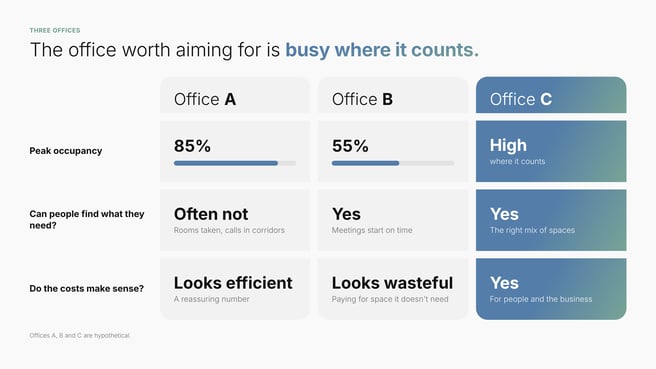
Picture two offices. Office A peaks at 85%. Leadership sees a busy building and a reassuring number to put next to operating costs. Employees see meeting rooms that are always taken, calls made in corridors and teams that can't sit together. Office B peaks at 55%. Some days whole areas are quiet, but people find the rooms they need and meetings start on time.
If occupancy is your KPI, Office A wins. If the office is there to help people work, Office B is doing better, though it may also be paying for space it doesn't need. What surprises me is how easily we can mistake a busy office for a successful one. I don't think either one is the answer, and a real building shows why.
One building, one year
We measured a European office for about a year, across 2025 and 2026. The company and location are anonymized, but every figure is the building's own. It has 922 workstations, 136 meeting rooms and 170 walk-in rooms over seven floors[2].
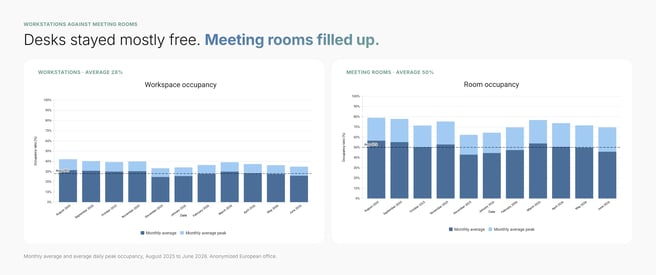
On a typical day, 76% of the workstations were used for at least 15 minutes. That sounds healthy. Across office hours, though, the same desks were occupied only 28% of the time. The two numbers answer different questions: was the desk used at all, and how long did anyone actually sit there?
Peak demand gives a third answer. Even on the busiest days, almost a quarter of desks stayed free, and that counts a desk as taken for up to an hour after someone leaves. Meeting rooms told a different story: 88% were in use at once on those same days. These figures look only at the busiest days, while the chart above shows the average daily peak for each month, which is why its numbers are lower for both desks and meeting rooms. The building wasn't simply full or empty. It had spare capacity in one type of space and much higher demand in another.
One more detail stood out. At 11:00 on an average Tuesday to Thursday, only about one in three people in the building were at a workstation. The rest were in meeting rooms, walk-in rooms, at shared tables or outside the sensors' coverage. That doesn't mean they weren't working. Being in the office simply isn't the same as sitting at a desk.
Then there's the size of the meetings. In rooms with people counters, half of all meetings had one or two people in them, and the building has no formal meeting room that small. Four in five involved four people or fewer, yet three in five rooms are built for five or more.
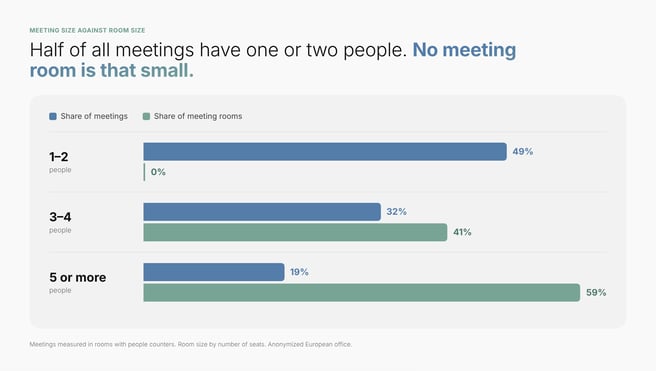
None of this automatically means the larger rooms are unnecessary. The 170 walk-in rooms may already absorb some of the demand, and we'd need to know how often large meetings overlap before taking any rooms away. A twelve-person room used by three people most days may still be the only place for the twelve-person meeting once a week. But it does raise a useful question: are we paying for the right mix of spaces, or simply keeping the layout we've always had?
What the booking system misses
At the same site, we compared more than 170,000 meeting room bookings with what the sensors recorded. One booking in seven was a no-show: the room was booked and nobody came. Measured in time, a fifth of booked hours were empty, and for a fifth of the time rooms were in use, nobody had booked them.
For employees, that means a room can look unavailable when it's empty, or available when someone is already using it. For the business, it means existing space isn't used as well as it could be. Before investing in more meeting rooms, the first step may be to make the ones you have easier to find and use: release rooms automatically when nobody turns up, and make unbooked use visible.
I work with sensors every day, and they have limits too. A sensor can tell you a room was in use. It can't tell you whether the meeting was any good, or whether it needed to happen in the office at all. For that you have to ask people. The CRE leader who wrote to me put it well: the workplace should entice, not mandate. I'd add that once people come in, it should support the reason they came.
Behavioral scientist Leidy Klotz, author of Subtract and In a Good Place, has argued that a successful workplace is less about offering more spaces or more choices than about giving people meaningful control over their environment, with options that support the work they need to do. As he explains in The Wall Street Journal, the goal is to give employees a genuine say in shaping their workplace, without overwhelming them with choices[3].
What to measure instead
I don't believe in a single workplace success score, and I'd be wary of anyone who claims one number can tell you everything. I would look at five things:
- Actual use: average and peak occupancy, by type of space.
- Suitability: can people find the right kind of space when they need it?
- Experience: what made today harder than it should have been?
- Support for work: did people find what they needed for the work they came in to do?
- Cost: what you pay per type of space, and per seat-hour actually used.
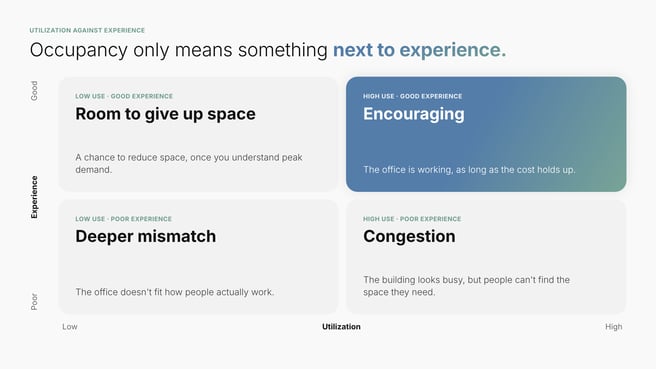
None of them works alone. High use with a poor experience means congestion. Low use with a good experience may be a chance to give up space, once you understand peak demand. Low use with a poor experience points to a deeper mismatch between the office and how people work. High use with a good experience is encouraging, as long as the cost holds up.
Subtract before you add
When an office isn't working, our first instinct is often to add something: another meeting room, another lounge, another booking rule. Research co-authored by Leidy Klotz, published in Nature in 2021, found that people systematically overlook solutions that involve taking something away[4].
When I look at the data from this building, I can't help wondering how many workplace problems we're trying to solve by adding more space, without fully understanding the space we already have. Meeting rooms booked but never used. Desks sitting empty even on the busiest days. Large rooms regularly occupied by one or two people. Perhaps the first question should be what we could do differently with what we already have, before we ask what else we need.
Of course, removing space isn't always the answer. A room that looks underused today might be essential tomorrow, which is why understanding when, where and how people use the office matters so much. And sometimes, that understanding makes much bigger decisions possible. One Nimway customer described how workplace data helped their leadership ahead of an upcoming lease period:
"Data from Nimway helped our company leadership confidently make a decision that saved us tens of millions of dollars during our upcoming lease period: to remove 20% of our office space. There is usually so much uncertainty around such a decision. But not with Nimway."
Workplace Experience Manager, European retail company, Sweden
What I find most interesting is the confidence behind the decision, as much as the 20% itself. Reducing office space is easy on a spreadsheet. Knowing what you can remove without making the workplace less useful is much harder, and that's where understanding how people actually use a workplace makes the difference.
The office worth aiming for is neither Office A nor Office B. Call it Office C: busy where it counts, with the right mix of spaces, where people can find what they need, and where the costs make sense for the business.
Before spending money to get there, I'd want two answers. Where does demand overlap, and could existing rooms take some of it? And what does each option cost next to the cheap ones, like better room discovery, automatic release or different booking rules? You will never have perfect information. You can still avoid an expensive decision based on a number that answers the wrong question.
Where to start
If cost is the brief, start small. Pick one building. Measure occupancy by type of space instead of one building-wide figure. Compare a month of bookings with actual use. After an office day, ask employees one question: did you find the space you needed? Together, those tell you more than any occupancy target, and they give you something solid to take to finance.
An office that's 80% full tells you people came. It doesn't tell you whether they found what they needed, or whether the business is getting what it pays for. Perhaps that's the place to start: asking whether our offices are working for the people who use them and the businesses that pay for them, and not only how full they are.
We've learned a great deal from analyzing this building. If you're facing similar questions, I'd be happy to share what we've learned.
What's one thing you wish your workplace data could tell you, but currently doesn't?
Sources
- CBRE, "The Hybrid Reality: Why the Office Is More Important Than Ever," 2026 Global Workplace & Occupancy Insights, Part 1, January 2026 (CBRE Workplace & Occupancy Benchmarking Program, global data).
- Nimway, anonymized customer site summary: 205 working days, August 31, 2025 to August 30, 2026. "Busy days" is the level reached on the busiest 5% of days, measured at each day's busiest quarter-hour. A desk counts as in use for up to 60 minutes after someone leaves. Offices A, B and C are hypothetical.
- Klotz, Leidy, "The Secret to Better Office Design Isn't the Office Design," The Wall Street Journal, 2026.
- Adams, Converse, Hales and Klotz, "People systematically overlook subtractive changes," Nature 592, 2021.